


LAUDA - Songs of community in 14th to 16th-century Italy
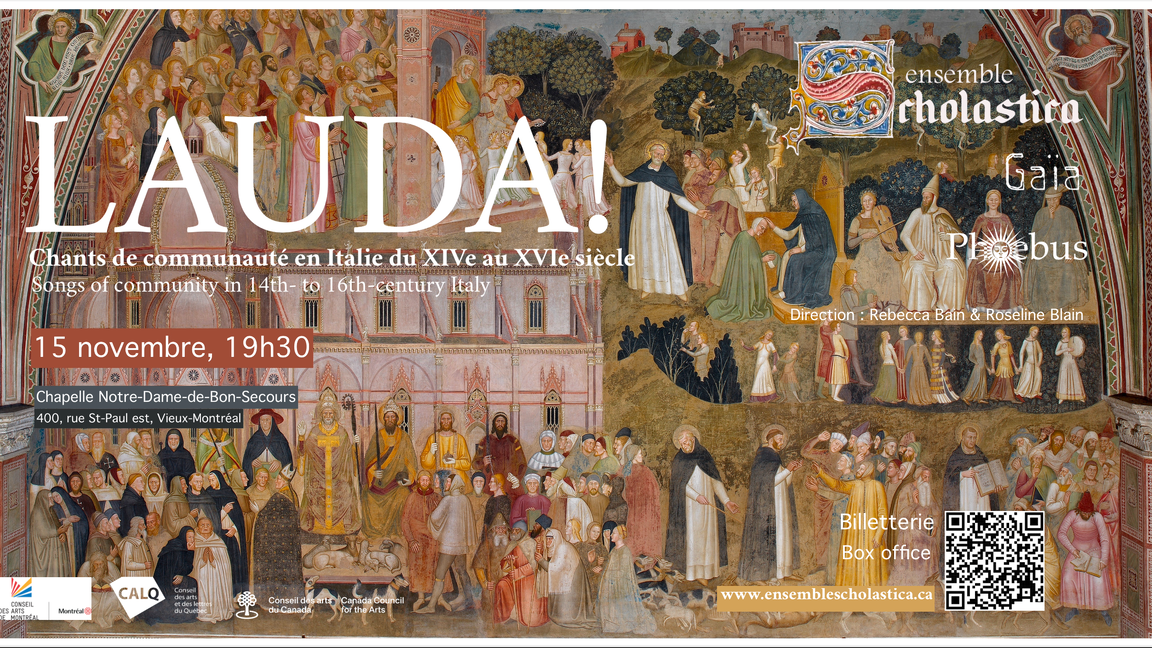


Fourteenth-century Florence: a prosperous city at the heart of Italian culture, a place of ideas and movements sowing the seeds of Italian democracy.
Inspired by Francis of Assisi and the mendicant movement he sparked a century earlier, the laudesi sought to democratize religious practice. Its members were not part of the Church hierarchy, and they created new rituals to be performed in the streets and homes of the merchant class. They commissioned music that they could sing in Italian instead of the Church’s Latin, creating a form known as the lauda.
The lauda alternates between verse and refrain, experienced and amateur voices, intimacy and community. Its language is devout yet passionate: liberated from the austere constraints of the Church, the repertoire displays the fervent joy of a community taking ownership of its own sacred experience. This movement spread to other Italian city-states and lasted into the 16th century.
For this program of beautiful and haunting laude, Ensemble Scholastica is thrilled to combine the forces of five of its singer-musicians (Rebecca Bain, Alice Boissinot Guastavino, Ariadne Lih, Angèle Trudeau & Leah Weitzner) with over a dozen voices from Ensembles Gaïa and Phoebus. Their leader and founder, the acclaimed Roseline Blain, will share the director’s podium with Ensemble Scholastica artistic director Rebecca Bain.
Join us on Sunday, November 15 at 7:30 p.m. in the sumptuous acoustic of the Chapelle Notre-Dame-de-Bon-Secours.
Artists
Collaborators
Roseline Blain
Artistic director
Rebecca Bain
Artistic director